
We aim to rapidly disseminate scientific research in the natural and life sciences to diverse communities through rigorous publication practices. Infinity is committed to maintaining high standards, establishing codes of conduct, and ethically handling allegations of misconduct, including plagiarism, misrepresentation, and data falsification. We follow the COPE Guidelines and adhere to its Best Practice Guidelines, focusing on transparency, early detection of ethical issues, fairness, and the protection of research participants' rights, while upholding ethical standards in research involving humans, animals, cells, and plants.
The peer-review and editorial processes are essential to producing high-quality scientific research. Infinity Journals uses a single-blind review system. All suitable manuscripts are evaluated by at least two expert reviewers selected by an editor or the Editor-in-Chief (EIC). Each manuscript undergoes peer review, and authors receive the first decision within three to five weeks of submission. We review all submitted manuscripts without selection bias, ensuring fairness, efficiency, and timely publication. The editorial board and reviewers are selected from among the top researchers in their respective fields.
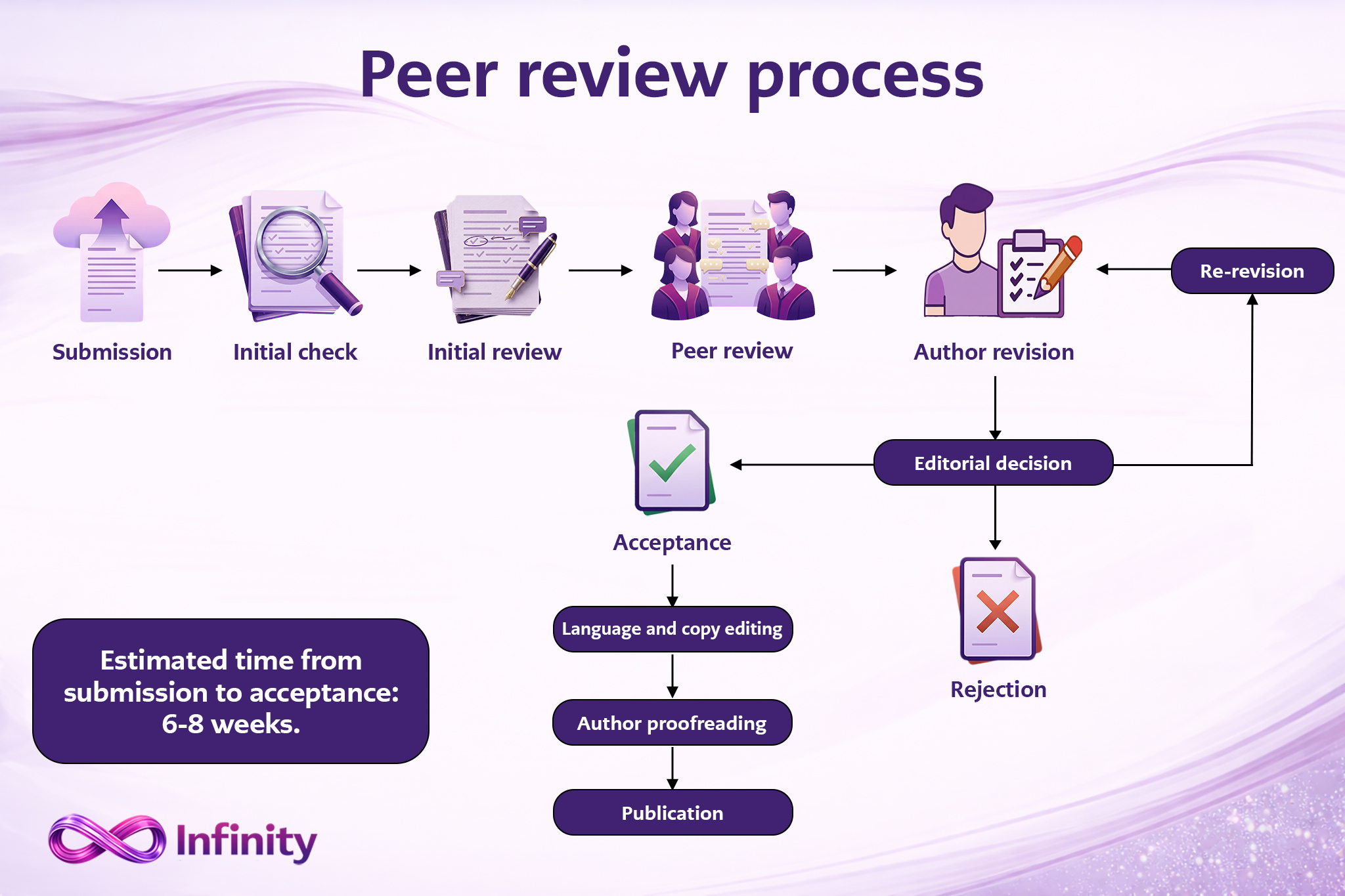
The peer review and editorial process includes the following steps:
Submission: Infinity journals provide an easy submission system (OJS/PKP) that simplifies the manuscript submission process. Authors can suggest potential reviewers and exclude those with conflicts of interest, ensuring a fair peer-review process. The journals also promote article submissions via email alerts and encourage authors to use the available author guidelines to prepare their manuscripts properly.
Initial check: After submission, all manuscripts undergo a pre-check to ensure they meet the journal's standards, including checks for originality, structure, relevance, references, and required declarations. Manuscripts that are poorly prepared may be rejected at this stage. The editorial office then conducts a technical review to confirm compliance with Infinity guidelines and policies. Next, the Editor-in-Chief assigns the manuscript to an Associate Editor (or Editor), taking any conflicts of interest into account.
Initial review: After the EIC’s initial check, the assigned associate editor, guest editor, or editor assesses the manuscript’s quality, novelty, and relevance to the journal before peer review. Editors are not permitted to access or make decisions about their own manuscripts. Work that is non-original, low-quality, plagiarized, or duplicated is rejected; manuscripts requiring minor revisions or missing basic sections are returned to authors; high-quality manuscripts with valid research questions proceed to peer review. Editors can track manuscript status and reviewer identities at any time, and reviewers and editors can communicate with the editorial office during the review process.
Peer review: Authors may suggest potential reviewers, but the editor may select other qualified experts. The editorial team ensures that reviewers have no conflicts of interest, hold at least a Ph.D., and have recent publications in the manuscript’s research area. Authors may also request that certain reviewers be excluded. Each manuscript is evaluated by at least two independent reviewers in a single-blind peer-review process, with typically no more than two rounds of major revisions. Editors consider reviewer recommendations, and authors must respond to all comments for both minor and major revisions. Revised manuscripts may be sent back to reviewers, who can access the latest version through the submission system.
Author revision: Based on reviewers’ comments and the manuscript’s quality, the assigned editor will decide whether to accept, request revisions, resubmit for review, or reject. Authors must submit minor revisions within one week and major revisions within two weeks, along with a point-by-point response to the reviewers’ comments.
Editorial decision: The assigned or guest editor makes the initial decision after confirming that all reviewer comments are addressed and that the manuscript meets publication standards. If revisions are insufficient, a second revision may be required. If the manuscript still does not meet standards after this, it may be rejected. The Editor-in-Chief makes the final decision. Accepted manuscripts proceed to production and publication.
Acceptance: After the manuscript is accepted, the editorial office will issue an acceptance notification to the authors.
Production: All accepted manuscripts undergo language and copy editing, including formatting to the journal style and XML conversion. A PDF proof is sent to authors for final review and proofreading before publication. The quality of figures, tables, and images is checked and, if necessary, improved. Professional English editing is provided. Comprehensive editing is available for an additional fee with author approval, though authors may also use other editing services.
Post-Publication Services: After production, all accepted articles are published electronically as PDFs and made available online. Published papers are tracked for total views, downloads, and citations to assess impact. Readers are encouraged to submit commentary, corrections, or corrigenda, which will be reviewed and linked to the original article. Authors may also share supplementary materials or updates after publication. For inquiries or correction submissions, contact the editorial office directly.
Figure showing the Peer Review Process at the Infinity Publisher
1. Editorial independence
The editorial policy is grounded in internationally recognized principles of publication ethics, scholarly integrity, and best-practice guidelines promoted by the Committee on Publication Ethics (COPE). Editorial decisions on all articles published in the journal are made independently by the Editor-in-Chief and the Editorial Board. The publisher, sponsors, owners, or any external parties do not influence decisions on the acceptance, rejection, or revision of manuscripts. All submissions are evaluated, and editorial decisions are based solely on:
Relevance of the study to the scope of the journal.
Scientific merit and originality of the work.
Quality of the methodological approach used in the work.
Adherence to ethical compliance.
2. Editorial accountability
Editors are responsible for ensuring objective, fair, and ethical editorial decision-making. They must act impartially, maintain confidentiality, avoid conflicts of interest, prevent unethical practices, and uphold scientific integrity throughout the publication process. The journal is committed to upholding high standards of publication ethics and adheres to internationally recognized best practices in scholarly publishing. Editors are expected to promote transparency, integrity, and ethical conduct in all aspects of the editorial and peer-review process.
3. Peer-review process
All submitted manuscripts undergo single-masked peer review by at least two independent experts in the relevant field. Authors may recommend potential reviewers; however, the academic editor may also suggest other qualified reviewers.
Peer reviewers are selected based on subject expertise, absence of conflicts of interest, and research and publication experience. Reviewers must hold at least a Ph.D. in the relevant field and have a number of recent publications in the manuscript's research area.
The journal follows COPE guidelines on Fairness, Confidentiality, Objectivity, and Timeliness. All revised manuscripts are returned to the reviewers for assessment of the authors' responses. Editors or associate editors make the initial decision on manuscript acceptance, and the EIC has final responsibility for acceptance or rejection. The EIC and editors are not permitted to handle their own manuscripts.
Under standard review conditions, the estimated timeline from manuscript submission to publication is 6–8 weeks. This process includes an initial quality check (1–3 days), peer review (3–4 weeks), editorial evaluation after review (3–7 days), the final decision (1–3 days), and production processing (1–7 days).
4. After acceptance
All accepted manuscripts will be forwarded to production, where our qualified production team will handle language editing, improve the quality of figures, images, and tables, and insert the manuscript into the journal template. If the manuscript requires comprehensive language editing, a professional English editor can provide support. This service is offered for an additional fee. The authors will be informed before this step is taken. Proofreading will be sent to the authors for review and approval. During this process, authors can contact the production office via email at production@infinity-ipc.org.
After completing all production steps, articles will be published online, enabling dynamic evaluation of views and downloads.
Reviewers are essential to ensuring the quality, integrity, and fairness of the peer-review process. All reviewers are expected to uphold the following ethical standards:
Appropriate Expertise: Reviewers should accept review assignments only when the manuscript falls within their field of knowledge and expertise. If they are not sufficiently qualified to evaluate the work, they should promptly inform the editorial board and decline the invitation.
Confidentiality: Manuscripts submitted for peer review, together with any supplementary materials, must be treated as confidential documents. Reviewers must not disclose, distribute, or use unpublished information obtained through the review process for personal or professional benefit.
Timely Review: Reviewers should complete their evaluations within the agreed timeframe. If circumstances prevent a timely review, they should notify the editorial board immediately so that appropriate arrangements can be made.
Ethical Responsibility: Reviewers should be attentive to potential ethical concerns, including plagiarism, duplicate publication, data fabrication or falsification, image manipulation, or other forms of research misconduct. Any concerns should be reported confidentially to the editorial board with supporting information whenever possible.
Objective and Constructive Assessment: Reviews should be conducted impartially and based solely on the scientific quality, originality, methodology, significance, and clarity of the manuscript. Feedback should be respectful, evidence-based, and aimed at improving the quality of the work.
Conflict of Interest: Reviewers must decline to review any manuscript if they have a financial, professional, institutional, or personal relationship that could influence, or reasonably be perceived to influence, their judgment. Any potential conflict of interest should be disclosed to the editorial board before the review begins.
Failure to comply with these ethical principles may result in the reviewer being removed from the journal's reviewer database and may affect future invitations to participate in the peer-review process.
Manuscripts are submitted through our online submission system (OJS), which supports an efficient and transparent peer-review process. Authors may suggest potential reviewers; however, the final selection of reviewers rests solely with the editors. By submitting a manuscript, the authors confirm that the work is original, has not been published previously, and is not under consideration for publication elsewhere, in whole or in part, except as a preprint, conference abstract, or lecture material, as permitted by the journal's publication policies.
All listed authors must have made a substantial contribution to the work, approved the submitted version of the manuscript, and agreed to its submission and publication.
The authors further confirm that, if the manuscript is accepted for publication, it will not be published elsewhere in the same or substantially similar form, in any language or medium, including electronic formats.
In accordance with COPE guidelines on citation manipulation and best publishing practices, all cited material, including the authors’ previously published work, must be accurately and appropriately referenced. All sources must be cited, and permission must be obtained when substantial portions of other publications or illustrative material are used.
The following practices are not acceptable in our journals:
i) Excessive or inappropriate self-citation; ii) Copying references from other publications without proper use or verification; iii) Targeted or preferential citation practices (e.g., citing an author’s institution or colleagues without scholarly justification); iv) Citation of promotional or advertising materials.
Copyright of all articles published in Infinity journals is retained by the author(s). All journals are open access, and articles are distributed under the terms of the Creative Commons Attribution-NonCommercial 4.0 International License (CC BY-NC 4.0). This license permits non-commercial use, distribution, and reproduction in any medium, provided that the original author(s) and copyright holder(s) are properly credited and the original publication in the journal is cited. All published material from other sources, such as figures, tables, photographs, graphs, and charts, must be used in accordance with their respective copyright licenses. Authors must obtain permission from copyright holders when required, particularly for material not covered by open licenses such as CC BY-NC 4.0. Permission is not required to create original tables based on published data or to use substantially modified figures. However, licenses may still be required for photos or charts created using specific tools, software, or websites.
Authors must obtain permission before submission to reproduce any copyrighted material (e.g., text, figures, tables, images) for which they do not hold the copyright. Our journals do not publish third-party material without written permission. Authors are responsible for securing all required licenses.
Permission is required for previously published work in which copyright was not retained, substantial extracts, unaltered or minimally modified data, and copyrighted images. Permission is not required for reconstructed or substantially modified data, provided the source is cited and copyright requirements are met. Where applicable, authors should state: “Reproduced with permission from [source].”
Authors are responsible for resolving all patent and intellectual property matters before publication.
The journals are committed to publishing original research and upholding the highest standards of academic integrity in accordance with the Committee on Publication Ethics (COPE) and the ICMJE recommendations. Accordingly, all submitted manuscripts will be screened for originality, plagiarism, self-plagiarism, and duplicate submission.
All submitted articles must not have been published or be under consideration elsewhere, in whole or in part, except as permitted (e.g., preprints or abstracts). Proper acknowledgment of all sources is required. Plagiarism in any form, including direct copying, mosaic plagiarism, self-plagiarism, data duplication, image manipulation, or unattributed reuse of text, ideas, or results, is unacceptable.
All manuscripts may be screened using plagiarism detection software. Suspected cases of plagiarism or redundant publication will be investigated in accordance with COPE guidelines. Depending on the severity, actions may include manuscript rejection, a request for revision, publication of a correction, or retraction of the article. Authors are responsible for ensuring the originality and integrity of their work prior to submission.
Research involving animals: All studies involving animal subjects must be approved by an ethics committee before they are conducted and must comply with relevant regulations. Authors must include details on housing, husbandry, and pain management. When using animals, authors must comply with the '3 Rs' (replacement, reduction, refinement) or refer to established animal care guidelines and regulations. If national laws don't mandate ethical approval, authors must explain why and label it as “not required” in the ethical statement. Infinity endorses the ARRIVE guidelines for reporting live animal studies.
Research conducted on Cell Lines: Studies involving cell lines should specify the origin of each cell line. For human-derived cell lines, include references, laboratory details, and sources from commercial providers or established collections; written informed consent must be obtained. Submissions that lack information or do not meet these requirements may be rejected.
All authors, reviewers, and editors must disclose any financial, institutional, professional, or personal relationships that could influence, or be perceived to influence, their work or editorial decisions. Consistent with internationally recognized publication ethics standards and the principles promoted by the Committee on Publication Ethics (COPE), any interests that may compromise the objectivity, integrity, or impartiality of the research, peer-review process, or editorial decision-making are considered potential conflicts of interest.
Authors are required to disclose all relevant conflicts of interest in a separate section of the manuscript entitled "Conflicts of Interest." This disclosure should include any circumstances, affiliations, funding sources, financial relationships, personal relationships, academic competition, or other interests that could improperly influence the presentation, interpretation, or evaluation of the research.
Reviewers and editors must disclose any conflicts of interest and, where appropriate, recuse themselves from the review or editorial handling of a manuscript. Failure to disclose relevant conflicts of interest may result in corrective actions, including rejection of the manuscript, publication of a correction, or retraction of the article, as appropriate.
Appeals
Authors may appeal a rejection decision by sending an appeal to the editorial office at appeals-complaints@infinity-ipc.org. Upon receipt of an appeal, the editorial office will forward it, along with the manuscript and relevant materials, to the handling editor or a newly designated editor, depending on the nature of the appeal. Authors must not submit the manuscript to another journal until a final decision is issued. The academic editor may uphold the original decision, request a revision, or seek additional peer review. A rejection decision approved by the Editor-in-Chief is final.
Complaints
All complaints are investigated fairly and confidentially. The editorial office handles complaints in accordance with COPE guidelines. Complaints related to ethical, scientific, or legal concerns regarding published articles or editorial processes may be submitted via the contact form or by email at appeals-complaints@infinity-ipc.org.
Readers are encouraged to contact the corresponding author first. If no satisfactory response is received, the editorial office will review the complaint and, if necessary, consult the Editor-in-Chief. Anonymous complaints and those raising valid ethical or scientific concerns will be assessed. Personal criticisms or differences in professional opinion will not be considered. Complainants will be informed of the outcome or the reason for dismissal and may request confidential handling.
Post-publication corrections and updates
Minor errors that do not affect the scientific meaning (e.g., spelling or formatting) may not require correction.
Corrigenda are issued for major errors affecting metadata, authorship, ethics, or scientific interpretation, including errors in data, figures, tables, author lists, affiliations, or key sections (e.g., funding or acknowledgments). Approved corrections are republished with a linked correction notice.
Author name changes requested for personal or privacy-related reasons (e.g., gender identity, marriage) may be made without issuing a public correction notice.
Retractions: We follow COPE recommendations for retractions. Articles may be retracted for serious errors, data fabrication, plagiarism, ethical violations, or other issues that compromise the integrity of the scholarly record. Retracted articles remain accessible with a clear retraction notice and watermark and must not be cited. Partial retractions may be issued when appropriate. In exceptional cases involving legal or safety concerns, articles may be removed from the website and from indexing services.
In line with the ICMJE recommendations and the Sex and Gender Equity in Research (SAGER) guidelines, authors should consider sex and gender as relevant variables in the design, analysis, and reporting of research. Authors should state whether sex- or gender-based differences were anticipated and how they were addressed. If no such study was performed, the rationale should be clearly explained. Authors are encouraged to review the full SAGER guidelines before submission.
When describing study settings, maps, institutional affiliations, or correspondence, authors should use neutral, internationally recognized designations. The journal remains neutral regarding jurisdictional claims and will address any related concerns in accordance with editorial policy.
The use of generative Artificial Intelligence (AI) in scholarly publishing offers potential benefits but raises important ethical considerations regarding transparency, accountability, authorship, data security, and research integrity. This policy provides guidance to authors, editors, and peer reviewers on the responsible use of generative AI, in accordance with COPE guidelines, ICMJE recommendations, and CSE standards.
Use of AI by Authors
Authors may use generative AI tools for limited purposes, such as language editing, improving grammar and clarity, organizing literature, coding support, and exploratory searches. Authors remain fully responsible for the accuracy, originality, and integrity of all content, including AI-assisted material. Any use of AI tools must be transparently disclosed in the manuscript (e.g., in the Declarations and Supplementary Information section) and must comply with data protection, confidentiality, and intellectual property requirements.
AI must not be used to generate substantial portions of the manuscript without meaningful human oversight; to replace scholarly judgment; to create or alter research data; to generate figures, tables, images, medical images, or mathematical content; or to produce misleading, unverifiable, or fabricated content (including abstracts or citations). Undisclosed or inappropriate use of AI may constitute misconduct and lead to rejection, correction, or retraction.
Use of AI by Editors
To protect confidentiality and research integrity, editors must not upload unpublished manuscripts or related materials to AI systems. Limited use of AI for administrative or language-related tasks is permitted only with prior approval and must comply with the publisher's Code of Conduct.
Use of AI by Peer Reviewers
Peer reviewers must not use generative AI tools to evaluate manuscripts, generate review reports, summarize content, or analyze submitted data or figures. All peer review comments must reflect the reviewer’s independent expert judgment. Misuse of AI in peer review constitutes a breach of confidentiality and may result in removal from the reviewer pool.
Policy Review
The publisher will periodically review and update this policy in response to technological and ethical developments. Significant updates will be communicated to authors, editors, and reviewers.
Self-Archiving
The Journal supports the broad dissemination and preservation of scholarly research through self-archiving. Authors retain copyright in their published works and may deposit the final published version of their article (Publisher’s PDF) in personal websites, institutional repositories, subject-specific repositories, and other non-commercial scholarly platforms without embargo and without prior permission from the Journal.
When depositing articles, authors must ensure that:
The Journal and Publisher are clearly acknowledged as the original source of publication.
Complete bibliographic and citation information is provided.
A link to the official published version of the article on the Journal’s website is included whenever available.
Public Accessibility
Authors may make their articles publicly available immediately upon publication. Deposited versions may be shared through institutional repositories, digital archives, personal websites, research networks, and other scholarly dissemination platforms, provided that proper attribution is maintained and the integrity of the published work is preserved.
Digital Preservation and Archiving
The Journal is committed to the long-term preservation and accessibility of its published content. All published articles are securely archived on the Publisher’s servers and maintained through appropriate digital preservation measures to ensure continued access.
In addition, the Journal endeavors to deposit article metadata and, where applicable and permitted, full-text PDF versions with the German National Library (Deutsche Nationalbibliothek, DNB) to support discoverability, accessibility, and permanent scholarly preservation.
The Journal may also participate in additional archiving and preservation initiatives as part of its ongoing commitment to ensuring the long-term availability of the scholarly record.
The Journal is committed to maintaining the integrity of the scholarly record and adheres to the principles outlined in the recommendations of the International Committee of Medical Journal Editors (ICMJE) and the guidelines of the Committee on Publication Ethics (COPE).
All submitted manuscripts must be original, not previously published, and not under consideration for publication elsewhere unless explicitly disclosed and permitted under the Journal's policies.
Research and publication misconduct, including but not limited to plagiarism, self-plagiarism, duplicate or redundant publication, data fabrication, data falsification, inappropriate image manipulation, citation manipulation, undisclosed conflicts of interest, and misrepresentation of authorship or contributions, is strictly prohibited.
The Journal reserves the right to screen submitted manuscripts using plagiarism-detection and other integrity-assessment tools. Allegations or evidence of misconduct, whether identified before or after publication, will be investigated in accordance with COPE guidance and established editorial procedures. Authors may be asked to provide explanations, original data, ethics approvals, or other supporting documentation during the investigation process.
Where misconduct is suspected or confirmed, the Journal may take appropriate corrective actions, including but not limited to manuscript rejection, publication of corrections or expressions of concern, article retraction, removal of content where legally required, and notification of the authors' institutions, funding agencies, or other relevant authorities when warranted.
The Journal is committed to conducting all investigations fairly, confidentially, and transparently, while ensuring due process for all parties involved.
The Journal is committed to promoting transparency, reproducibility, and responsible research practices. In accordance with the recommendations of the International Committee of Medical Journal Editors (ICMJE), the guidelines of the Committee on Publication Ethics (COPE), and the FAIR Data Principles (Findable, Accessible, Interoperable, and Reusable), authors are responsible for ensuring the accuracy, integrity, and proper management of all data underlying their published research.
Authors must ensure that the collection, storage, analysis, and reporting of research data comply with applicable ethical standards, legal requirements, institutional policies, and data protection regulations, including requirements related to privacy, confidentiality, and informed consent, where applicable.
The Journal encourages authors to make research data openly available whenever possible by depositing datasets in appropriate, trusted, and publicly accessible repositories. Authors should provide a Data Availability Statement within their manuscript indicating whether the underlying data are available and, if so, where and how they can be accessed.
Where data cannot be shared due to ethical, legal, contractual, privacy, confidentiality, or other legitimate restrictions, authors must clearly state the reasons for the restriction in the Data Availability Statement and, where feasible, describe the conditions under which access may be granted.
The Editors reserve the right to request access to the underlying data, supporting documentation, or other research materials during the peer-review process or after publication to verify the validity, integrity, and reproducibility of the reported findings. Authors are expected to retain original research data and related records for a reasonable period following publication and to make them available upon justified request, subject to applicable legal and ethical constraints.
Failure to comply with the Journal’s requirements regarding data integrity, availability, or transparency may result in editorial actions, including manuscript rejection, publication of a correction or expression of concern, article retraction, or other measures deemed appropriate by the Editors.
Infinity Journals operates under a fully open-access publishing model. All articles are published under the Creative Commons Attribution-NonCommercial 4.0 International License (CC BY-NC 4.0), which permits non-commercial use, distribution, and reproduction in any medium, provided that the original author(s) and copyright holder(s) are properly credited and the original publication in the journal is cited.
To cover the costs of editorial management, peer-review administration, production, online hosting, dissemination, archiving, and long-term preservation, an Article Processing Charge (APC) is payable for manuscripts accepted for publication.
The current APC rates are published on the Journal’s website and are subject to periodic review.
Editorial decisions are based exclusively on the scholarly quality, originality, significance, and integrity of submitted work. The ability of authors or their institutions to pay the APC does not influence editorial evaluation or publication decisions. APC invoices are issued only after a manuscript has been formally accepted for publication. Payment of an APC does not guarantee acceptance.
The Journal does not charge submission, review, or processing fees for rejected manuscripts. No additional charges are imposed based on article length, number of figures, tables, color images, or supplementary materials unless otherwise stated on the Journal’s website.
The following article types are normally published without an APC: Editorials, Corrections, Addenda, Retractions, Expressions of Concern, and other invited content as determined by the Editors.
APC Waivers and Discounts
The Journal is committed to ensuring that financial circumstances do not prevent the publication of high-quality research. Full or partial APC waivers may be granted to authors who lack access to adequate funding, including authors from low- and middle-income countries, early-career researchers, and authors conducting unfunded or underfunded research.
Waiver requests are assessed on a case-by-case basis according to the Journal’s waiver criteria and available funding resources. All requests are handled confidentially and independently of the editorial and peer-review process. The outcome of a waiver request will not influence the editorial assessment of a manuscript.
Authors seeking an APC waiver should submit a formal waiver request that includes the manuscript title, journal name, corresponding author details, and a brief explanation of the circumstances supporting the request. Requests should be sent to: waiver@infinity-ipc.org.
The Journal reserves the right to approve, partially approve, or decline waiver requests based on the information provided and the availability of waiver support.